
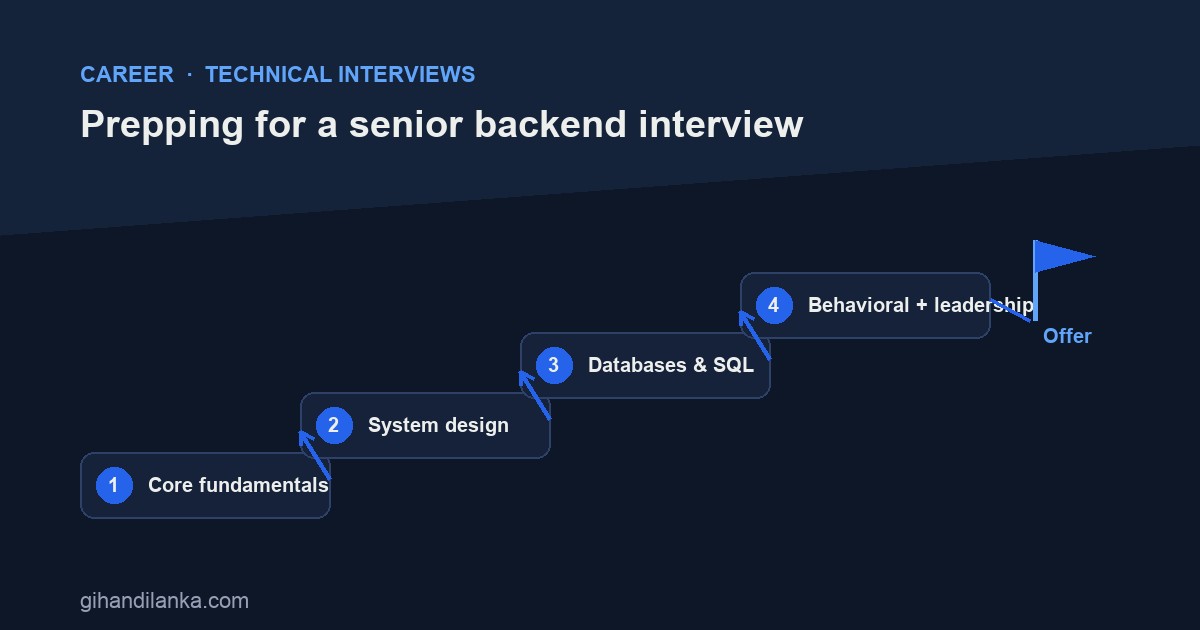
If you prepare for a senior backend interview the way you did for your first job — grinding algorithm puzzles — you’ll be ready for the wrong interview. At the senior level, companies aren’t checking whether you can reverse a linked list. They’re checking whether you can design a system, reason about trade-offs, and lead. Here’s a focused prep plan built around what actually gets tested.
1. Fundamentals — applied, not memorized
You still need data structures and algorithms, but the bar is different. Nobody expects you to recite a red-black tree from memory. They expect you to reach for the right structure under real constraints and explain why — “a hash map here because lookups dominate,” “this is O(n²) and the input can be large, so let’s fix it.” Practice enough to be fluent and calm, then stop. Beyond fluency, extra puzzle-grinding has steeply diminishing returns for a senior role.
2. System design — this is the main event
This is where senior interviews are won or lost. You’ll be asked something open-ended — “design a URL shortener,” “design the notifications system” — and judged on how you think, not whether you memorized an architecture. The move is to drive the conversation: clarify requirements and scale first, sketch the high-level components, then go deep where it matters (the data model, the bottleneck, the failure modes). Talk about trade-offs out loud — consistency vs. availability, SQL vs. NoSQL, caching and its invalidation pain. Interviewers want to see an engineer who weighs options, not one who declares a single “right” answer.
Prepare by designing a handful of real systems end to end and explaining them aloud, as if to a colleague. If you can’t explain your design clearly to another person, you can’t explain it in an interview either.
3. Databases & SQL — the backend’s heart
Backend seniority shows in how well you understand data. Expect questions on indexing (and why the wrong index — or a missing one — tanks a query), transactions and isolation, how to spot and kill an N+1, and when to denormalize. Be ready to read a slow query and reason about what the database is actually doing.
-- "Why is this slow, and how would you fix it?"
SELECT * FROM orders
WHERE customer_id = 42
ORDER BY created_at DESC
LIMIT 20;

-- A senior answer: it's doing a full scan + filesort.
-- A composite index on (customer_id, created_at) lets the DB
-- seek straight to this customer's rows, already ordered.
CREATE INDEX idx_orders_customer_created ON orders (customer_id, created_at);
4. Behavioral & leadership — not a formality
At senior level the behavioral round carries real weight, because the job is partly about influence. You’ll be asked about a hard technical decision you drove, a conflict you navigated, a production incident you owned, a time you mentored someone. Prepare specific stories — real situations, your actions, the outcome — rather than generic answers. The signal interviewers want: do you take ownership, do you make good calls under uncertainty, and do you make the people around you better? “We” is fine, but be clear about what you did.
What interviewers are actually scoring
Across every round, the same meta-signals come up. Communication: can you think out loud and bring the interviewer along? Judgment: do you weigh trade-offs instead of chasing the “perfect” answer? Depth: when they push on a topic, is there real understanding underneath? Ownership: do you sound like someone who takes responsibility for outcomes? A candidate who’s a bit rusty on syntax but clearly reasons well will out-interview a human compiler almost every time.
A simple prep plan
- Weeks 1–2: refresh fundamentals to fluency, no further.
- Weeks 2–4: system design daily — design, sketch, explain aloud.
- Ongoing: drill database/SQL reasoning on real slow queries.
- Throughout: write out 6–8 behavioral stories and practice telling them tightly.
- Before the real thing: do mock interviews. Performing the knowledge is a separate skill from having it.
The takeaway
A senior backend interview rewards range, not grind. Be fluent in fundamentals, strong in system design, sharp on databases, and genuine in the behavioral round — and above all, communicate your thinking clearly. Prepare for that interview, and you’ll walk in ready for the one they’re actually running.