
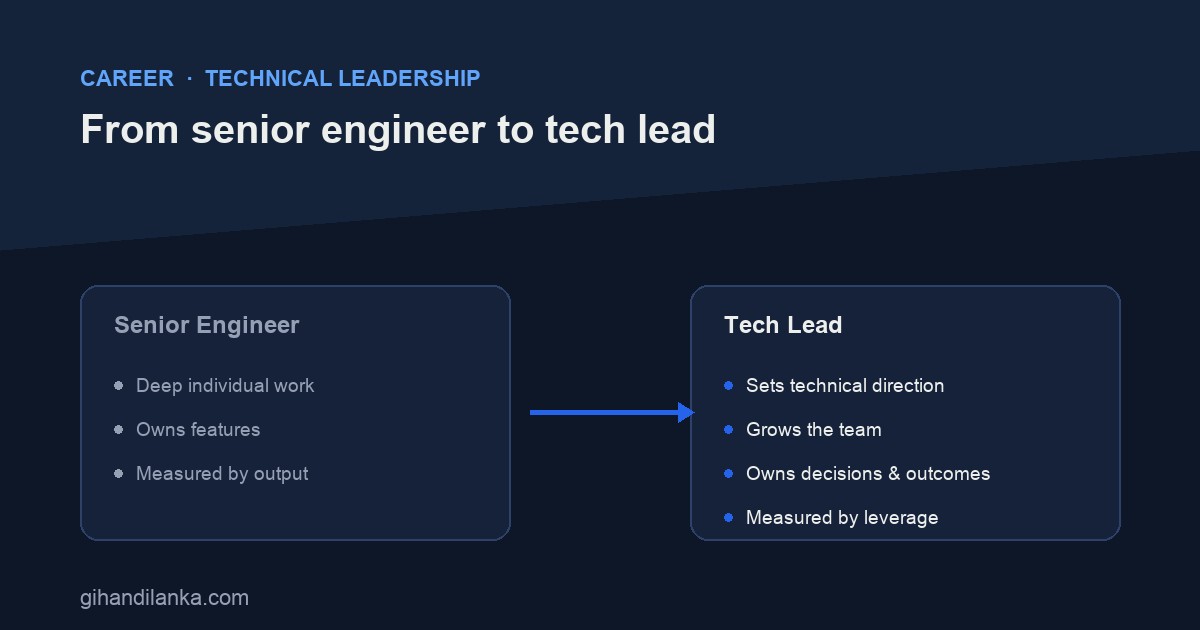
Most people become a tech lead by being the best engineer on the team, and then spend the first few months confused about why it isn’t working. The reason is simple: leading isn’t a bigger version of engineering. The thing that got you here — personal output — is no longer the main thing you’re measured on. Here’s what actually changes, and the trap that catches nearly everyone.
From output to leverage
As a senior engineer, your value is what you produce. As a tech lead, your value is what the team produces — and your job is to multiply it. Unblocking four engineers so they ship this week is worth far more than the feature you’d have written yourself. This is the core reframe: you’ve gone from being a strong individual contributor to being a force multiplier. The math of your impact changes, so the way you spend your time has to change with it.
The trap: trying to still do all the coding
Here’s where most new leads stumble. Coding is comfortable and measurable; leading is ambiguous and slow to show results. So they cling to the keyboard, take the hardest tickets for themselves, and become the bottleneck — the person three others are waiting on. The team slows down precisely because the lead is “being productive.” Letting go of being the one who writes the most code is the hardest and most important part of the transition. You still code — but selectively, and never at the expense of the team’s flow.
What you pick up
Technical direction. You now own the “where are we going” — the architecture, the standards, the big technical calls. Not by decree, but by building alignment so the team moves in one direction instead of five.
Decisions under uncertainty. Harder calls flow to you, often without a clearly right answer. The team doesn’t need you to be infallible; they need you to make a reasoned call, explain the trade-offs, and own the outcome. Deciding with incomplete information — and being accountable for it — is the job.
Growing people. Your reviews, your pairing, the problems you hand to a junior who’s ready to stretch — these shape the team’s ceiling. A lead who makes everyone around them better produces more than any single engineer ever could.
Communication as the main interface. You’re now the translation layer — between the team and stakeholders, between the vision and the code. Writing clear docs, running focused discussions, and explaining technical reality to non-technical people stops being a nice-to-have and becomes most of the job.
What you let go of
Being the person with their name on the most commits. Solving every hard problem personally. The clean, immediate feedback loop of “I wrote code, it works, I’m done.” Leadership results come slower and fuzzier — a team that ships smoothly, engineers who grew, decisions that aged well. Learning to find satisfaction in that, rather than in your own output, is the real mindset shift.
The takeaway
Becoming a tech lead means trading personal output for team leverage: setting direction, making and owning decisions, growing people, and communicating relentlessly — while resisting the urge to hoard the coding. The engineers who make this shift well don’t become less technical; they aim their technical judgment at the whole team instead of a single ticket. Do that, and you stop being the best engineer on the team and start being the reason the team is good.